One poem, two different experiences
While our innate belovedness by the Creator of everything is the same, our experiences in life and faith vary in endless ways. One of the ways this truth is lived out is when offering a contemplative practice to begin a session of Spiritual Direction.
Beginning sessions with a contemplative practice is one way we intentionally enter into a session of Spiritual Direction together. As we move through a routine of awareness of self and the Loving Presence of God, to a few rounds of breath together, then a check-in and prayer, we land at a space of practice. During this time, the practice varies by directee— what is their temperament? How do they feel most connected to God? What stirs within me as I practice discernment and prayer with God about what kind of practice to offer them? While practices vary from directee to directee, with the liturgical calendar as a guide, I will often bring in something suited to the season.
This past week, I realized that I wouldn’t be seeing my directees again until Easter. Our monthly rhythm landing us mid-April for our next sessions. Between our sessions and the next, we will have moved through the entirety of Holy Week including Palm Sunday, Maundy Thursday, Good Friday, Holy Saturday, and Easter Sunday… and still have time after that! This realization had me curious about what would stir to offer my directees. From the buffet of readings and practices I love to offer over this time of year, I can only do one with each directee and for two sessions, I leaned into an old favourite.
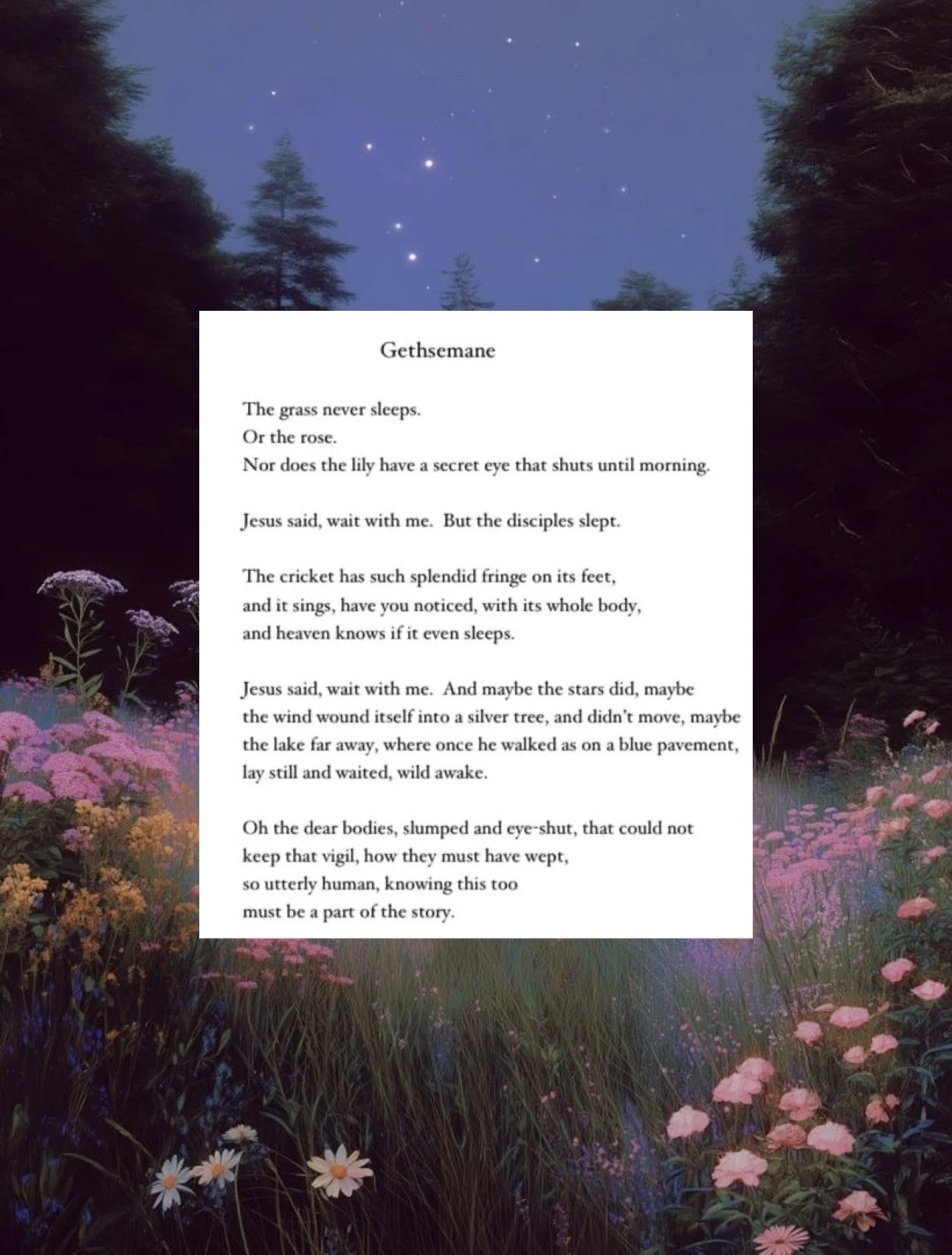
The poem Gethsemane by Mary Oliver has been a favourite since the first time I read it. Discovered in her book ‘Devotions’, this poem invites us into the garden of Gethsemane not as a main character, but as a ‘fly on the wall’ kind of witnessing— present, curious, wonder-filled. In the poem, she invites us to be curious about creation and if it sleeps. The disciples, as we know from the story, did. Did the stars? Did the flowers? These are the questions the poem invites us to hold.
A gift of Spiritual Direction is tailoring something as simple as the reading of a poem to each directee.
With the first directee, who loves meeting with God in colours spread onto a page in crayon, the invitation was aPraying In Colour Exercise:
With the context as the garden of Gethsemane, put colours to page to create a garden image. It can be literal, drawing what you would image would be in the garden, or you could use clumps of colour or shapes to represent different aspects of the garden. The reminder that there is no right or wrong, just the experience of trusting the stirrings of colour and shapes to create a garden.
Add Jesus to the garden, where you’d imagine Him. Once more, no right or wrong, however you’d like to draw something that represents him.
Add where you see yourself in the garden. Again, no right or wrong, just where would you imagine yourself in the garden.
The readings begin: The first reading of the poem is just to take it in. To hear the words. To let is soak your imagination. The second reading was an opportunity to add what stood out or stirred to the page in shape and colour, letting the poem add another layer of depth to what you’ve already been creating.
Enjoy time creating with the Creator. Break the silence when you’re ready.
With the second directee, who loves imaginative prayer, the invitation was to imagine the scene with added layers as the poem was read through Imaginative Prayer:
The first reading is to take in the poem; to hear it, to get familiar with the reading and begin to allow the image to be painted in your mind. Letting the words shape a vision and create a scene.
The second reading was to imagine Jesus in the garden— where is he? What is he doing? What is it like for him to be there
The third reading was to imagine yourself in the garden— where are you? What are you doing? How do you feel being there?
Enjoy time in silence, being present to the story. Break the silence when you’re ready.
Both of these practices (while certainly abbreviated to the space and time of spiritual direction), did two things:
They met the directee with where they are at; in the places they naturally feel most connected to God.
It invited them into a familiar story in an unfamiliar way, breaking the often disenchantment we can feel to something we’ve heard time and time again to find that sense of enchantment and wonder what the story holds.
Each directee was stirred to something different that landed meaningfully with where they are at with their relationship with God. For one, it was the idea of creation coming and being with Jesus. For the other, it was the utter humanity of the disciples. No discovery better than the other, no meaning better than the other— both significant to the directee and spurred on the conversation about their current experience and awareness of God.
This is something that, even after offering spiritual direction for 6 years, I’ll never lose my own sense of enchantment with. The stirring of the spirit within each person, the movement of the session, is truly so awe-inspiring.
If you’d like to engage in a practice with this poem yourself, I have a traditional Lectio Divina offering ready for you to dive into.
If you’re curious about Spiritual Direction, and would like to meet with a director who enjoys tailoring spiritual practices to who you are and how you naturally connect to God, I would be beyond excited to connect with you. Click here to learn more and connect.
Gethsemane by Mary Oliver
The grass never sleeps.
Or the roses.
Nor does the lily have a secret eye that shuts until morning.
Jesus said, wait with me. But the disciples slept.
The cricket has such splendid fringe on its feet,
and it sings, have you noticed, with its whole body,
and heaven knows if it ever sleeps.
Jesus said, wait with me. And maybe the stars did, maybe
the wind wound itself into a silver tree, and didn’t move,
maybe
the lake far away, where once he walked as on a
blue pavement,
lay still and waited, wild awake.
Oh the dear bodies, slumped and eye-shut, that could not
keep that vigil, how they must have wept,
so utterly human, knowing this too
must be a part of the story